
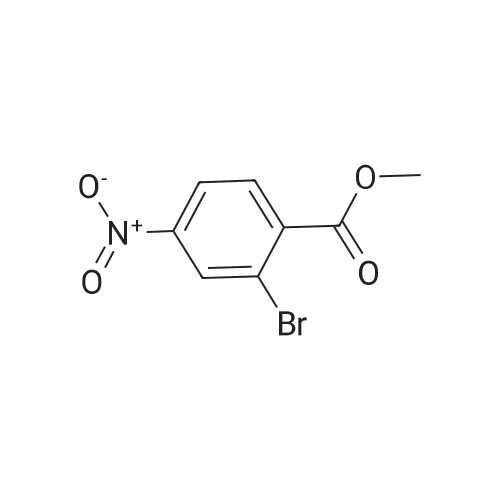
Cat.NO.:A139667 Purity:97%
Product Details of [ 100959-22-6 ]
| CAS No. : | 100959-22-6 |
| Formula : |
C8H6BrNO4 |
| M.W : |
260.04
|
| SMILES Code : | O=C(OC)C1=CC=C([N+]([O-])=O)C=C1Br |
| MDL No. : | MFCD07779271 |
| Boiling Point : | No data available |
| InChI Key : | XYMZAFDNPJLOTP-UHFFFAOYSA-N |
| Pubchem ID : | 15833211 |
Safety of [ 100959-22-6 ]
| GHS Pictogram: |  |
| Signal Word: | Warning |
| Hazard Statements: | H315-H319-H335 |
| Precautionary Statements: | P261-P305+P351+P338 |
Computational Chemistry of [ 100959-22-6 ] Show Less
Physicochemical Properties
| Num. heavy atoms | 14 |
| Num. arom. heavy atoms | 6 |
| Fraction Csp3 | 0.12 |
| Num. rotatable bonds | 3 |
| Num. H-bond acceptors | 4.0 |
| Num. H-bond donors | 0.0 |
| Molar Refractivity | 54.24 |
| TPSA ?
Topological Polar Surface Area: Calculated from |
72.12 Ų |
Lipophilicity
| Log Po/w (iLOGP)?
iLOGP: in-house physics-based method implemented from |
1.83 |
| Log Po/w (XLOGP3)?
XLOGP3: Atomistic and knowledge-based method calculated by |
2.7 |
| Log Po/w (WLOGP)?
WLOGP: Atomistic method implemented from |
2.14 |
| Log Po/w (MLOGP)?
MLOGP: Topological method implemented from |
1.58 |
| Log Po/w (SILICOS-IT)?
SILICOS-IT: Hybrid fragmental/topological method calculated by |
0.25 |
| Consensus Log Po/w?
Consensus Log Po/w: Average of all five predictions |
1.7 |
Water Solubility
| Log S (ESOL):?
ESOL: Topological method implemented from |
-3.27 |
| Solubility | 0.139 mg/ml ; 0.000534 mol/l |
| Class?
Solubility class: Log S scale |
Soluble |
| Log S (Ali)?
Ali: Topological method implemented from |
-3.87 |
| Solubility | 0.0353 mg/ml ; 0.000136 mol/l |
| Class?
Solubility class: Log S scale |
Soluble |
| Log S (SILICOS-IT)?
SILICOS-IT: Fragmental method calculated by |
-2.71 |
| Solubility | 0.507 mg/ml ; 0.00195 mol/l |
| Class?
Solubility class: Log S scale |
Soluble |
Pharmacokinetics
| GI absorption?
Gatrointestinal absorption: according to the white of the BOILED-Egg |
High |
| BBB permeant?
BBB permeation: according to the yolk of the BOILED-Egg |
Yes |
| P-gp substrate?
P-glycoprotein substrate: SVM model built on 1033 molecules (training set) |
No |
| CYP1A2 inhibitor?
Cytochrome P450 1A2 inhibitor: SVM model built on 9145 molecules (training set) |
Yes |
| CYP2C19 inhibitor?
Cytochrome P450 2C19 inhibitor: SVM model built on 9272 molecules (training set) |
Yes |
| CYP2C9 inhibitor?
Cytochrome P450 2C9 inhibitor: SVM model built on 5940 molecules (training set) |
No |
| CYP2D6 inhibitor?
Cytochrome P450 2D6 inhibitor: SVM model built on 3664 molecules (training set) |
No |
| CYP3A4 inhibitor?
Cytochrome P450 3A4 inhibitor: SVM model built on 7518 molecules (training set) |
No |
| Log Kp (skin permeation)?
Skin permeation: QSPR model implemented from |
-5.97 cm/s |
Druglikeness
| Lipinski?
Lipinski (Pfizer) filter: implemented from |
0.0 |
| Ghose?
Ghose filter: implemented from |
None |
| Veber?
Veber (GSK) filter: implemented from |
0.0 |
| Egan?
Egan (Pharmacia) filter: implemented from |
0.0 |
| Muegge?
Muegge (Bayer) filter: implemented from |
0.0 |
| Bioavailability Score?
Abbott Bioavailability Score: Probability of F > 10% in rat |
0.55 |
Medicinal Chemistry
| PAINS?
Pan Assay Interference Structures: implemented from |
0.0 alert |
| Brenk?
Structural Alert: implemented from |
2.0 alert: heavy_metal |
| Leadlikeness?
Leadlikeness: implemented from |
No; 1 violation:MW<0.0 |
| Synthetic accessibility?
Synthetic accessibility score: from 1 (very easy) to 10 (very difficult) |
1.97 |
Application In Synthesis of [ 100959-22-6 ]
* All experimental methods are cited from the reference, please refer to the original source for details. We do not guarantee the accuracy of the content in the reference.
- Downstream synthetic route of [ 100959-22-6 ]
[ 100959-22-6 ] Synthesis Path-Downstream 1~4
- 1
 [ 100959-22-6 ]
 [ 98545-64-3 ]
| Yield | Reaction Conditions | Operation in experiment |
|---|---|---|
| 94.2% | With tin(II) chloride dihdyrate; In ethyl acetate; for 4h;Reflux; | To a solution of compound 20 (4.5g, 17.0mmol) in EtOAc (100mL) was added SnCl2·2H2O (38.3g, 0.17mol). The mixture was heated to reflux and stirred for 4h. The mixture was poured into saturated NaHCO3 (500mL) and EtOAc (370mL). The organic layer was washed with brine (300mL), and dried over anhydrous MgSO4. The residue after rotary evaporation was purified by column chromatography over silica gel to give compound 21 as a solid (3.68g, 94.2% yield). 1H NMR (400MHz, CDCl3): delta 7.75 (d, J=8.5 Hz, 1H), 6.92 (d, J=2.2Hz, 1H), 6.57 (dd, J=8.5, 2.2Hz, 1H), 4.04 (brs, 2H) and 3.86 (s, 3H) ppm; mp: 96-98C. |
| To a suspension of 2-bromo-4-nitro-benzoic acid methyl ester [100959-22-6] (350 mg, 1.35 mmol) in MeOH (60 mL) were subsequently added tin powder (1.6 g, 13.5 mmol) and 3N aqueous HCI (27.8 mL, 83 mmol). The mixture was stirred overnight at RT. The liquid phase was decanted from the excess tin and neutralized by adding a saturated aqueous NaHC03 solution. An equal amount of water by volume was added and the water phase was extracted with EtOAc (3x). The combined organics were dried (Phase Separator) and concentrated in vacuo. The residue was purified by flash column chromatography on silica gel (eluent: EtOAc/c-hexane 1 :4) to give the title compound as yellow solid. MS (LC/MS): 230 [M+H]+; tR (HPLC conditions b): 2.89 min. |
[2]Chinese Chemical Letters,2011,vol. 22,p. 1411 – 1414.
[3]European Journal of Medicinal Chemistry,2014,vol. 81,p. 59 – 75.
[4]Organic Process Research and Development,2019,vol. 23,p. 1686 – 1694.
[5]Academia Republicii Populare Romine, Baza de Cercetari Stiintifice, Timisoara, Studii si Cercetari, Stiinte Chimice,1956,vol. 4,p. 175,178.
[6]Patent: WO2012/93101,2012,A1 .Location in patent: Page/Page column 236-237.
- 2
- [ 100959-22-6 ]

 [ 7439-89-6 ]
- [ 98545-64-3 ]
| Yield | Reaction Conditions | Operation in experiment |
|---|---|---|
| 95% | With ammonium chloride; In aqueous 2-propanol; | Example 54C methyl-2-bromo-4-aminobenzoate A solution of methyl 2-bromo-4-nitrobenzoate (970 mg, 3.73 mmol), iron powder 1.25 g (22.4 mmol) and ammonium chloride (239 mg, 4.48 mmol) in aqueous 2-propanol (20%, 15 mL) was heated to reflux for 30 minutes, cooled, filtered, and concentrated under reduced pressure. The residue was partitioned between diethyl ether (20 mL) and water (5 mL). The organic layer was washed with brine (1*5 mL), dried (MgSO4), filtered, and concentrated to provide the titled compound (813 mg, 95%). |
- 3
- [ 100959-22-6 ]
 [ 32338-02-6 ]
- [ 98545-64-3 ]
| Yield | Reaction Conditions | Operation in experiment |
|---|---|---|
| 96.0% | Next, the nitro group of methyl 2-bromo-4-nitrobenzoate (6.38 g, 24.6 mmol) was chemoselectively reduced with 5 nCl2.2H2O (27.8 g, 123.2 mmol) in a manner similar to that described for compound 6 to deliver methyl 4-amino-2-bromobenzoate in 96.0% (5.41 g) yield as a yellow solid. 1H-NMR (CDCl3, 400 MHz) delta 7.74 (1H, d, J=8.8 Hz, Ar), 6.90 (1H, d, J=1.6 Hz, Ar), 6.55 (1H, dd, J=8.8 Hz, 1.6 Hz, Ar), 4.06 (2H, s, NH2), 3.83 (3H, s, OCH3); 13C-NMR (CDCl3, 100 MHz) delta 165.9, 150.4, 133.6, 124.1, 119.7, 119.6, 112.7, 51.8; MS (ESI) m/z Calcd for C8H8BrNO2 (M+): 229.0, Found: 230.1 (M+H+). |
- 4
 [ 454482-11-2 ]
- [ 100959-22-6 ]
- C14H16N2O4 [ No CAS ]
| Yield | Reaction Conditions | Operation in experiment |
|---|---|---|
| 99% | With (1,1′-bis(diphenylphosphino)ferrocene)palladium(II) dichloride; caesium carbonate; In 1,4-dioxane; water; at 90℃; for 2h;Inert atmosphere; | To a solution ofmethyl 2-bromo-4-nitrobenzoate (CAS: 100959-22-6) (2.00 g, 7.69 mmol) in 1,4-dioxane (20 mL) were added H.O (10 mL), Cs2CO; (5.00 g, 15.38 mmol), <strong>[454482-11-2]1-methyl-4-(4,4,5,5-tetramethyl-1,3,2-dioxaborolan-2-yl)-1,2,3,6-tetrahydropyridine</strong> (CAS: 454482-11-2) (2.60 g, 11.54 mmol) and Pd(dppfhCl. (562 mg, 0.77 mmol). The reaction was stirred under Ar at 90 C for 2h. The cooled reaction mixture wasdiluted with water (200 mL) and extracted with EtOAc (200 mL X 3). The combined organic extracts were washed with water (200 mL X 3), dried over anhydrous NaoSOsx,filtered and concentrated. The residue was purified by silica gel chromatography (eluent: DCM/MeOHfrom 40/1 to 30/1, v/v) to give intermediate 160 (2.1 g, 99% yield) as a brownoil. |

Reviews
There are no reviews yet.